
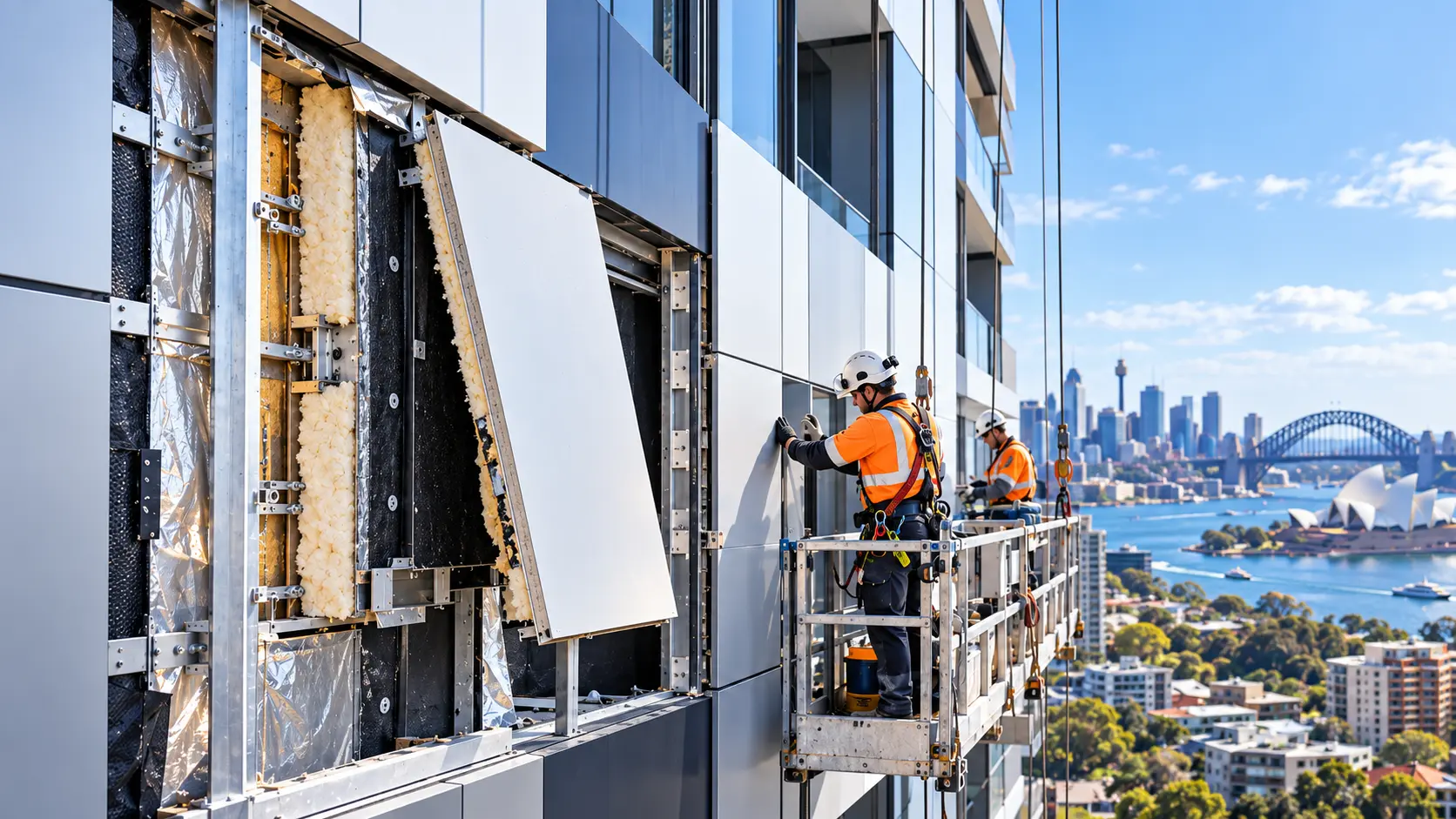
Combustible cladding is external wall material that can ignite, spread fire, or add fuel under fire conditions. In Sydney and across NSW, most of the concern centres on aluminium composite panels (ACP) with polyethylene cores. These panels were widely used on apartment buildings, commercial properties, and public buildings for decades before the fire risks became fully understood.
If you own an apartment in a building with combustible cladding, or you sit on a strata committee managing one, you need to understand what you’re dealing with, what the law requires, and what your options are. This guide covers the essentials.
This article provides general information about combustible cladding in NSW. It is not legal, regulatory, or building advice. For guidance specific to your building, consult a qualified building professional and your consent authority.
What Makes Cladding Combustible?
Cladding is the material or system attached to the outside of a building to provide weather protection, insulation, and appearance. Not all cladding is a fire risk. The problem is specifically with materials that can catch fire or help flames spread up the face of a building.
The most common offender in Australia is aluminium composite panel with a polyethylene (PE) core. These panels look like solid aluminium from the outside, but they’re actually a sandwich: two thin aluminium sheets with a plastic core in between. The aluminium itself doesn’t burn, but the polyethylene core does. When exposed to heat, the aluminium skin can deform and expose the plastic core, which ignites and allows fire to travel rapidly up the building’s exterior.
Under the National Construction Code, non-combustibility is a laboratory result, not a judgment call. A material either passes the AS 1530.1 test or it doesn’t. ACP with a PE-core fails that test because the polymer core is combustible.
There are two regulatory thresholds worth understanding. NSW Fair Trading issued a product ban on PE-core ACP with more than 30 per cent combustible content by mass. The Cladding Product Safety Panel, advising Project Remediate, went further, recommending removal of composite cladding above 8 per cent combustible core. Two thresholds, two purposes: the ban restricts what can be sold, the panel’s recommendation guides what should be removed from existing buildings. Getting that distinction right matters for any building owner evaluating their position.
Other cladding materials can also be combustible, including some expanded polystyrene (EPS) systems and certain insulated panels with organic cores. But PE-core ACP is the material that prompted the nationwide regulatory response.
Why Did It Take So Long to Recognise the Risk?
PE-core ACP was popular for good reasons. It was lightweight, cost-effective, easy to work with, and gave buildings a modern, clean facade. It was used on thousands of buildings across Australia from the 1990s onward. The risks were known in engineering circles, but it took real-world disasters to force regulatory action.
At 2.35am on 25 November 2014, a fire started in an ashtray on the balcony of apartment 805 at the Lacrosse building in Melbourne’s Docklands. It spread from level 8 to the roof above level 21 in roughly 11 minutes. All 400 occupants were evacuated safely, but the speed of the fire’s spread shocked the industry. The subsequent investigation directly linked the rapid vertical fire spread to the PE-core ACP cladding on the building’s exterior. In 2019, VCAT found the builder, architect, building surveyor, and fire engineer liable.
Three years later, the Grenfell Tower fire in London in June 2017 killed 72 people. Combustible cladding was again a central factor. Grenfell changed the political urgency entirely. Governments across Australia, the UK, and internationally moved to audit existing buildings and restrict the use of combustible cladding materials on new ones.
How Do You Know If Your Building Is Affected?
In NSW, the Cladding Taskforce was established in 2017 to identify buildings with potentially combustible cladding. The Taskforce audited building records and inspected thousands of buildings across the state.
If your building has been identified as high-risk, your owners corporation has likely already been contacted by your local council or by the Office of Project Remediate. You may have received a fire safety order requiring remediation within a specific timeframe.
But not every building with some ACP on it is automatically high-risk. The presence of combustible cladding does not by itself determine the building’s fire risk. A building-specific assessment is needed to evaluate the type of cladding, the extent of coverage, the building’s height and class, existing fire safety measures, and the overall risk profile. Some buildings may require full replacement. Others may need only partial remediation or additional fire safety measures.
If you’re unsure whether your building is affected, start by checking with your strata manager or owners corporation. They should have records of any correspondence from the Cladding Taskforce, your local council, or Fire and Rescue NSW.
What Happens If You Don’t Replace It?
For buildings that have received a fire safety order, ignoring it is not an option. Fire safety orders issued by local councils or Fire and Rescue NSW are legally enforceable. Non-compliance can result in fines, further enforcement action, and personal liability for strata committee members who fail to act.
Beyond legal enforcement, there are practical consequences. Many insurers now require evidence that combustible cladding has been addressed before renewing or offering cover. Buildings that haven’t acted may face policy exclusions, significant premium increases, or inability to obtain insurance at all. For apartment owners, this also affects resale. Lenders are increasingly cautious about properties in buildings with known cladding issues, and buyers are understandably wary.
What Are Your Options for Replacement
Building owners in NSW now have one realistic pathway for replacing combustible cladding: private remediation.
Project Remediate, the NSW Government’s program for eligible Class 2 (residential apartment) buildings, provided interest-free loans repayable over 10 years through Lannock Strata Finance and project management assurance through Hansen Yuncken as the government-appointed managing contractor. The program was extended to 2027, with more than $105 million in targeted investment. However, registrations have now closed and new enquiries are not being accepted. Buildings already registered continue through the program.
For any building coming to this fresh, private remediation means appointing your own contractor and managing the process independently. This gives your owners corporation control over the timeline, design choices, and costs, but it also means taking on the coordination and compliance responsibilities directly.
All cladding remediation work on Class 2 buildings in NSW must comply with the Design and Building Practitioners Act 2020, regardless of pathway. That means registered practitioners, regulated designs lodged on the NSW Planning Portal, and compliance declarations.
One important difference between the two pathways concerns Home Building Compensation Fund (HBCF) insurance. Project Remediate buildings could apply for an exemption. Private remediation cannot, because cladding replacement work is classified as repair under the Home Building Act. On a private job, the builder must hold HBCF cover before work starts, and it should be visible in the quote.
For a full overview of the recladding process and what to look for in a contractor, see our facade recladding service page.
How Fidem Can Help
Fidem has direct experience delivering combustible cladding replacement on occupied buildings in Sydney, including the Watermark Towers residential project and the Alfred House commercial project. We manage the full scope of work from assessment and design through to compliant installation and handover, so your owners corporation isn’t left coordinating multiple specialists.
We hold an iCIRT rating, ISO 9001:2015 (Quality) and ISO 14001:2015 (Environmental) certification, a documented safety management system, and government prequalification on NSW procurement panels. If you’re dealing with combustible cladding on your building and need a builder you can trust with the process, contact Fidem or call 02 7813 7020 to discuss your situation.
Frequently Asked Questions
What is combustible cladding?
Combustible cladding is external wall material that can ignite, contribute to fire spread, or add fuel under fire conditions. The most common type in Australia is aluminium composite panel (ACP) with a polyethylene core. The aluminium exterior doesn’t burn, but the plastic core does, allowing fire to travel rapidly up a building’s facade.
How do I know if my building has combustible cladding?
Check with your strata manager or owners corporation first. If your building was identified by the NSW Cladding Taskforce, your owners corporation should have received correspondence from your local council or the Office of Project Remediate. A facade assessment by a qualified professional can confirm the type and extent of cladding on your building.
Is all ACP cladding dangerous?
Not necessarily. The fire risk depends on the core material. NSW Fair Trading banned PE-core ACP with more than 30 per cent combustible content by mass. The Cladding Product Safety Panel went further, recommending removal of composite cladding above 8 per cent combustible core. A building-specific assessment is needed to evaluate the actual risk profile.
Who pays for combustible cladding replacement?
In most cases, the owners corporation bears the cost. Some owners corporations have pursued legal recovery against the parties responsible for specifying or installing the non-compliant cladding.
Can my owners corporation still join Project Remediate?
No. Registrations for Project Remediate have closed and new enquiries are not being accepted. Buildings already registered continue through the program. For any building coming to this fresh, private remediation, appointing your own contractor and managing the process independently, is now the realistic pathway.
What happens if we don't replace combustible cladding after a fire order?
Fire safety orders issued by local councils or Fire and Rescue NSW are legally enforceable. Non-compliance can result in fines, further enforcement action, and personal liability for strata committee members. Insurers may also void or restrict cover on buildings that fail to act on known fire safety risks.
Can I sell my apartment if the building has combustible cladding?
You can, but it will likely affect the sale. Buyers and their lenders will factor in the cladding risk, the status of any remediation, and whether the building has a plan in place. Buildings that have completed remediation or have a funded plan tend to sell more easily than those with unresolved issues.