
Facade Recladding Sydney: Compliant Cladding Replacement for Residential and Commercial Buildings

Auther

Will

Published On

September 28, 2026

Categories

Uncategorized

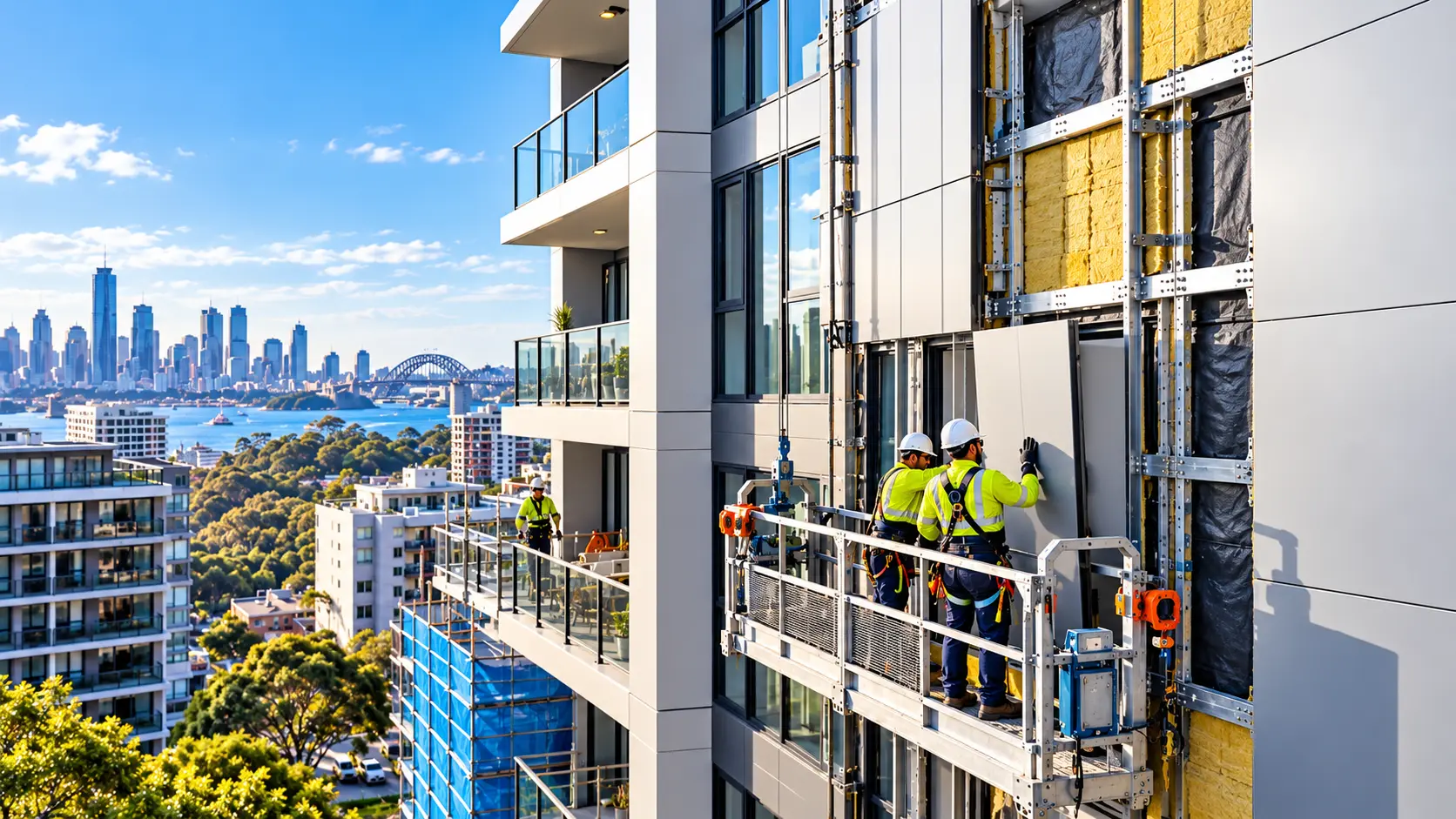
Facade recladding in Sydney by Fidem on a residential apartment building

Fidem delivers facade recladding and cladding replacement for residential apartment buildings, commercial properties, and government assets across Sydney. We manage the full scope of work, from initial assessment and design documentation through to compliant installation and handover, so your building meets current fire safety standards without the coordination headaches.

If your building has been issued a fire safety order, or you know non-compliant cladding needs to go, you need a builder who understands the regulatory framework, can manage work on an occupied building, and has the credentials to satisfy your insurer, your strata committee, and the consent authority. That’s what we do.

This page provides general information about facade recladding in NSW. It is not legal, regulatory, or building advice. For guidance specific to your building, consult a qualified building professional and your consent authority.

What Does Facade Recladding Involve?

Facade recladding is the removal of non-compliant or deteriorating external cladding and its replacement with materials that meet current fire safety and building code requirements. For most Sydney buildings, this means replacing aluminium composite panels with polyethylene (PE) cores, the material at the centre of Australia’s combustible cladding crisis.

The process starts with assessment and testing. A facade engineer and fire safety consultant will identify the cladding type, the extent of non-compliance, and any underlying substrate or structural issues that need to be addressed before new cladding goes on.

From there, the project moves into design documentation. Under the Design and Building Practitioners Act 2020 (NSW), a registered design practitioner must prepare a Construction Issued Regulated Design (CIRD) and lodge it on the NSW Planning Portal before building work begins.

Once design is lodged, the physical work begins: stripping non-compliant panels, repairing or upgrading the substrate, and installing the new compliant cladding system. On occupied buildings, this needs to be staged carefully to manage access, weatherproofing, noise, and resident safety. You cannot strip a whole elevation at once and leave people exposed to the weather.

Finally, the consent authority (usually your local council) needs to confirm that the remediation satisfies the fire safety order. Your insurer will also reassess premiums and cover once the work is documented and signed off.

What makes facade recladding different from a standard construction project is the complexity of working on an occupied building with an active compliance deadline. You’re coordinating residents, strata managers, engineers, certifiers, and regulators, all while keeping the building weathertight and liveable throughout.

Why Do Sydney Buildings Need Cladding Replaced?

It comes down to fire safety. Aluminium composite panels with PE-cores can ignite and spread fire rapidly up a building’s exterior. The 2017 Grenfell Tower disaster in London and the 2014 Lacrosse building fire in Melbourne’s Docklands brought the issue into public focus worldwide.

In NSW, the Cladding Taskforce audited building records and inspected thousands of buildings across the state to identify those with potentially high-risk combustible cladding. The statewide audit originally identified 338 high-risk residential apartment buildings.

Buildings identified as high-risk may receive a fire safety order from their local council or Fire and Rescue NSW, requiring the owners corporation to remove and replace the non-compliant cladding within a specified timeframe. These orders are legally enforceable. They are not optional.

Fire orders aren’t the only driver, though. Many insurers now require evidence that combustible cladding has been addressed before offering or renewing cover, and those that do insure affected buildings often impose significant premium increases and exclusions. On the resale side, apartments in buildings with known cladding issues face buyer hesitancy, mortgage restrictions from lenders, and reduced property values.

What Is the Current Position on Project Remediate?

Project Remediate is the NSW Government’s program to support the removal of combustible cladding from eligible high-risk Class 2 (residential apartment) buildings. It provided interest-free loans repayable over 10 years through Lannock Strata Finance, and project management assurance through Hansen Yuncken as the government-appointed managing contractor.

Registrations for Project Remediate have now closed and new enquiries are not being accepted. Buildings already registered continue through the program. The program was originally planned as a three-year initiative and was extended to 2027, with more than $105 million in targeted government investment.

For any building coming to this fresh, private remediation is now the realistic pathway. That means appointing your own contractor and managing the process independently, with the same compliance obligations as the government program: registered practitioners, regulated designs lodged on the NSW Planning Portal, and compliance declarations under the Design and Building Practitioners Act 2020.

The Building (Approvals and Practitioners) Act 2026 (NSW) passed in August 2026 and will repeal the DBP Act once commenced. A commencement date has not been proclaimed and the regulations have not been made. The core compliance obligations, including registered practitioners, regulated designs, and duty of care provisions, carry across to the new framework. Nothing in the current process changes until commencement, but building owners should be aware the legislative framework is in transition.

One important difference between the two pathways that most owners corporations are not aware of concerns Home Building Compensation Fund (HBCF) insurance. Buildings within Project Remediate could apply for an exemption from HBCF requirements. Private remediation cannot, because cladding replacement work is classified as repair under the Home Building Act. On a private job, the builder must hold HBCF cover before work starts, and it should be visible in the quote. This is a real trap for owners corporations who don’t check before signing.

What Should You Look for in a Facade Recladding Contractor?

Choosing the wrong contractor for a cladding remediation project is expensive and risky, both financially and legally. The building’s consent authority, insurer, and strata committee will all scrutinise the builder’s credentials, and any compliance shortfall at handover can mean rework, delays, and personal liability for committee members.

Registration under the Design and Building Practitioners Act is the non-negotiable starting point. For any Class 2 residential building work in NSW, the builder must be registered as a building practitioner under the DBP Act. This is not optional. Registration requires a contractor licence or supervisor certificate under the Home Building Act 1989, demonstrated practical experience, and completion of mandatory learning modules through the Construct NSW platform. Without DBP registration, the builder cannot lodge regulated designs or issue compliance declarations on the NSW Planning Portal.

Many people assume that an iCIRT rating is the essential credential. It’s valuable, but it’s a trust indicator, not a legal requirement. The Independent Construction Industry Rating Tool, developed by Equifax in consultation with the NSW Building Commissioner, independently assesses a builder’s trustworthiness across six areas: capability, conduct, character, capacity, capital, and counterparties. Builders with three or more gold stars appear on the public register. An iCIRT rating adds confidence, but what really matters is licensing and experience.

Beyond credentials, owners corporations should verify three things before engaging any contractor.

First, that the consultant team, particularly the facade engineers, has genuine facade experience. Facade remediation is a specialist discipline, and not every engineer who can design a structure can design a compliant replacement facade system.

Second, that the design meets current BCA and National Construction Code requirements. The design must satisfy the consent authority and your building certifier, not just the builder’s own assessment.

Third, that the builder understands facade systems well enough to deliver the design to a standard that will pass certification. Experience matters here because removing cladding often exposes waterproofing failures, deteriorated substrates, and other building defects that weren’t visible before. A builder who has been through this before knows what to expect and how to manage it. One who hasn’t will discover it on your project.

ISO certification is another strong signal, particularly for occupied buildings where safety and environmental management aren’t optional. Look for ISO 9001 (quality) and ISO 14001 (environmental), along with a documented safety management system.

Government prequalification adds further assurance. Builders on NSW government procurement panels have already passed probity, financial, and capability assessments.

Hold Your Contractor to the Government’s Own Checklist

The Office of Project Remediate publishes a checklist of twenty questions for owners corporations remediating privately. It is the strongest independent resource available for evaluating a remediation contractor, and very few building owners know it exists.

These are the questions from that checklist that matter most, and the ones we invite you to put directly to Fidem or any builder you’re considering.

Does your contractor have an iCIRT rating? An iCIRT rating is independently verified by Equifax and is the NSW Building Commissioner’s recommended trust benchmark. Fidem holds an iCIRT rating.

Are they qualified to fix latent defects such as drainage, spandrels, moisture barriers, fire barriers, window openings and slab edges? A cladding quote is rarely just cladding, and many defects are only discovered once the existing panels come off. Your contractor needs the capability to address what’s behind the cladding, not just what’s on the surface.

Will your fire safety order actually be lifted? The whole point of remediation is clearing the order. If the work isn’t certified, the order can’t be lifted. Your contractor should be able to demonstrate how they manage the compliance pathway from design through to certification and sign off by the consent authority.

Is compulsory HBCF insurance in their quote? Project Remediate used to cover HBCF requirements for buildings in the program. On a private remediation, the builder must hold HBCF cover before work starts. If it’s not in the quote, ask why.

Who monitors the contractor on your behalf? On a project of this scale and regulatory sensitivity, independent oversight matters. Understand who is accountable for quality assurance and compliance verification during construction.

Will you have monthly project control group (PCG) meetings? Remediation on an occupied building runs for months. PCG meetings bring together the design team, consultants, builder, client, and the client’s project manager to review progress, risks, and anything outstanding. If your contractor isn’t offering structured monthly reporting and review, ask what their alternative is.

Inviting this level of scrutiny is not something every builder is comfortable with. We are.

Why Fidem for Facade Recladding in Sydney?

Most facade recladding contractors are facade specialists. They install panels. But facade contractors generally don’t hold a building licence, which means they can’t obtain HBCF insurance. On a private remediation, that’s a problem, because HBCF cover is compulsory before work starts.

Fidem is a licensed builder. That distinction matters because it means we’re eligible for HBCF, registered under the DBP Act, and able to lodge regulated designs and issue compliance declarations directly. We don’t need to bring in a separate licensed entity to satisfy the regulatory requirements that your consent authority, your insurer, and your strata committee will all be checking.

We hold an iCIRT rating, independently verified by Equifax across the six areas of trustworthiness that matter most to strata bodies and procurement officers. We hold ISO 9001:2015 (Quality) and ISO 14001:2015 (Environmental) certification, along with a documented safety management system. We’re listed on NSW government procurement panels, with direct experience delivering projects for the Aboriginal Housing Office and the Office of Project Remediate.

Founded in 2009 by Michael and Emmanuel Ghobrial, our leadership team brings over four decades of combined experience across construction.

The best proof is the work itself. Fidem delivered compliant cladding replacement on the Watermark Towers project, managing the full scope of removal, design, and reinstallation on an occupied multi-storey residential building. Watermark Towers is exactly the kind of project that tests everything facade recladding demands: regulatory compliance, occupied building logistics, strata coordination, and a result that satisfies the consent authority, the insurer, and the residents.

We also bring experience across commercial construction, including the Alfred House project, as well as government projects and multi-residential builds. That means if your facade remediation uncovers substrate issues, structural concerns, or scope that extends beyond the cladding itself, you’re not coordinating a second builder.

What Does Facade Recladding Cost in Sydney?

There’s no single answer. Costs depend on the building’s height, facade area, cladding type, substrate condition, access method, the extent of underlying defects discovered during removal, and the compliance documentation required.

A cladding quote is rarely just cladding. A functioning facade usually involves moisture barriers, window heads, insulation, and support systems. Quotes have to be compared like-for-like, which means understanding what’s included and what’s excluded before you sign anything.

Scaffolding is often the single biggest line item in a remedial facade job. That’s worth knowing because it means doing other necessary facade work under the same scaffold, rather than returning later for a second mobilisation, is almost always cheaper.

Rather than publishing a price range that could mislead, we prefer to assess your building and give you a realistic scope and cost estimate based on what’s actually there. That assessment typically includes a facade condition review, a compliance gap analysis, and a preliminary program and budget, all before you commit to anything.

If cost uncertainty is your biggest concern, it’s worth asking about our early contractor involvement (ECI) approach. Bringing Fidem in during the assessment and design phase, before the remediation contract is let, reduces the gap between what’s designed and what’s built. That gap is where cost blowouts live. Call 02 7813 7020 to discuss ECI for your building.

Ready to Address Your Building’s Cladding?

Whether you’ve received a fire safety order, you’re preparing a remediation scope for your owners corporation, or you simply need a builder who understands the compliance pathway for private remediation in NSW, we’re here to help.

The first step is a conversation. We’ll review your building’s situation, discuss the compliance pathway, and give you an honest assessment of scope, timeline, and cost, with no obligation.

Contact Fidem or call 02 7813 7020 to arrange an initial consultation.

Frequently Asked Questions

What is facade recladding?

Facade recladding is the removal and replacement of a building’s external cladding, typically to address fire safety non-compliance. In Sydney, most recladding projects involve replacing aluminium composite panels with combustible PE-cores with non-combustible alternatives that meet current National Construction Code requirements.

Timelines vary by building size, facade complexity, and access constraints. A mid-rise residential building of six to twelve storeys may take six to eighteen months from design documentation to completion. Occupied buildings require staged work programs that add time but protect residents.

In most cases, yes. Facade recladding is typically managed so the building remains occupied throughout. Work is staged by elevation or zone, with weatherproofing, noise management, and safety controls in place. Fidem’s experience on occupied buildings means we plan around residents, not despite them.

At minimum, look for a current NSW builder’s licence, relevant project experience on occupied buildings, and the ability to manage Design and Building Practitioners Act compliance, including registered practitioners, CIRD lodgement, and compliance declarations. An iCIRT rating provides independent verification of a builder’s trustworthiness. Government prequalification and ISO certification for quality and environmental management add further assurance.

On a private remediation, cladding replacement is classified as repair under the Home Building Act. The builder must hold Home Building Compensation Fund cover before work starts. This is compulsory and it should be visible in the quote. If it isn’t, raise it before you sign. Project Remediate buildings could apply for an exemption, but that pathway is no longer accepting new registrations.

Early contractor involvement (ECI) brings the builder into the assessment and design phase before the remediation contract is let. This closes the gap between what’s designed on paper and what’s actually required on site, which is where cost blowouts and program delays typically originate. For facade remediation, where hidden defects behind the cladding are common, ECI gives the owners corporation much greater certainty on scope, cost, and timeline.


Facade Recladding Sydney: Compliant Cladding Replacement for Residential and Commercial Buildings

Auther

Will

Published On

September 28, 2026

Categories

Uncategorized

Facade recladding in Sydney by Fidem on a residential apartment building

Fidem delivers facade recladding and cladding replacement for residential apartment buildings, commercial properties, and government assets across Sydney. We manage the full scope of work, from initial assessment and design documentation through to compliant installation and handover, so your building meets current fire safety standards without the coordination headaches.

If your building has been issued a fire safety order, or you know non-compliant cladding needs to go, you need a builder who understands the regulatory framework, can manage work on an occupied building, and has the credentials to satisfy your insurer, your strata committee, and the consent authority. That’s what we do.

This page provides general information about facade recladding in NSW. It is not legal, regulatory, or building advice. For guidance specific to your building, consult a qualified building professional and your consent authority.

What Does Facade Recladding Involve?

Facade recladding is the removal of non-compliant or deteriorating external cladding and its replacement with materials that meet current fire safety and building code requirements. For most Sydney buildings, this means replacing aluminium composite panels with polyethylene (PE) cores, the material at the centre of Australia’s combustible cladding crisis.

The process starts with assessment and testing. A facade engineer and fire safety consultant will identify the cladding type, the extent of non-compliance, and any underlying substrate or structural issues that need to be addressed before new cladding goes on.

From there, the project moves into design documentation. Under the Design and Building Practitioners Act 2020 (NSW), a registered design practitioner must prepare a Construction Issued Regulated Design (CIRD) and lodge it on the NSW Planning Portal before building work begins.

Once design is lodged, the physical work begins: stripping non-compliant panels, repairing or upgrading the substrate, and installing the new compliant cladding system. On occupied buildings, this needs to be staged carefully to manage access, weatherproofing, noise, and resident safety. You cannot strip a whole elevation at once and leave people exposed to the weather.

Finally, the consent authority (usually your local council) needs to confirm that the remediation satisfies the fire safety order. Your insurer will also reassess premiums and cover once the work is documented and signed off.

What makes facade recladding different from a standard construction project is the complexity of working on an occupied building with an active compliance deadline. You’re coordinating residents, strata managers, engineers, certifiers, and regulators, all while keeping the building weathertight and liveable throughout.

Why Do Sydney Buildings Need Cladding Replaced?

It comes down to fire safety. Aluminium composite panels with PE-cores can ignite and spread fire rapidly up a building’s exterior. The 2017 Grenfell Tower disaster in London and the 2014 Lacrosse building fire in Melbourne’s Docklands brought the issue into public focus worldwide.

In NSW, the Cladding Taskforce audited building records and inspected thousands of buildings across the state to identify those with potentially high-risk combustible cladding. The statewide audit originally identified 338 high-risk residential apartment buildings.

Buildings identified as high-risk may receive a fire safety order from their local council or Fire and Rescue NSW, requiring the owners corporation to remove and replace the non-compliant cladding within a specified timeframe. These orders are legally enforceable. They are not optional.

Fire orders aren’t the only driver, though. Many insurers now require evidence that combustible cladding has been addressed before offering or renewing cover, and those that do insure affected buildings often impose significant premium increases and exclusions. On the resale side, apartments in buildings with known cladding issues face buyer hesitancy, mortgage restrictions from lenders, and reduced property values.

What Is the Current Position on Project Remediate?

Project Remediate is the NSW Government’s program to support the removal of combustible cladding from eligible high-risk Class 2 (residential apartment) buildings. It provided interest-free loans repayable over 10 years through Lannock Strata Finance, and project management assurance through Hansen Yuncken as the government-appointed managing contractor.

Registrations for Project Remediate have now closed and new enquiries are not being accepted. Buildings already registered continue through the program. The program was originally planned as a three-year initiative and was extended to 2027, with more than $105 million in targeted government investment.

For any building coming to this fresh, private remediation is now the realistic pathway. That means appointing your own contractor and managing the process independently, with the same compliance obligations as the government program: registered practitioners, regulated designs lodged on the NSW Planning Portal, and compliance declarations under the Design and Building Practitioners Act 2020.

The Building (Approvals and Practitioners) Act 2026 (NSW) passed in August 2026 and will repeal the DBP Act once commenced. A commencement date has not been proclaimed and the regulations have not been made. The core compliance obligations, including registered practitioners, regulated designs, and duty of care provisions, carry across to the new framework. Nothing in the current process changes until commencement, but building owners should be aware the legislative framework is in transition.

One important difference between the two pathways that most owners corporations are not aware of concerns Home Building Compensation Fund (HBCF) insurance. Buildings within Project Remediate could apply for an exemption from HBCF requirements. Private remediation cannot, because cladding replacement work is classified as repair under the Home Building Act. On a private job, the builder must hold HBCF cover before work starts, and it should be visible in the quote. This is a real trap for owners corporations who don’t check before signing.

What Should You Look for in a Facade Recladding Contractor?

Choosing the wrong contractor for a cladding remediation project is expensive and risky, both financially and legally. The building’s consent authority, insurer, and strata committee will all scrutinise the builder’s credentials, and any compliance shortfall at handover can mean rework, delays, and personal liability for committee members.

Registration under the Design and Building Practitioners Act is the non-negotiable starting point. For any Class 2 residential building work in NSW, the builder must be registered as a building practitioner under the DBP Act. This is not optional. Registration requires a contractor licence or supervisor certificate under the Home Building Act 1989, demonstrated practical experience, and completion of mandatory learning modules through the Construct NSW platform. Without DBP registration, the builder cannot lodge regulated designs or issue compliance declarations on the NSW Planning Portal.

Many people assume that an iCIRT rating is the essential credential. It’s valuable, but it’s a trust indicator, not a legal requirement. The Independent Construction Industry Rating Tool, developed by Equifax in consultation with the NSW Building Commissioner, independently assesses a builder’s trustworthiness across six areas: capability, conduct, character, capacity, capital, and counterparties. Builders with three or more gold stars appear on the public register. An iCIRT rating adds confidence, but what really matters is licensing and experience.

Beyond credentials, owners corporations should verify three things before engaging any contractor.

First, that the consultant team, particularly the facade engineers, has genuine facade experience. Facade remediation is a specialist discipline, and not every engineer who can design a structure can design a compliant replacement facade system.

Second, that the design meets current BCA and National Construction Code requirements. The design must satisfy the consent authority and your building certifier, not just the builder’s own assessment.

Third, that the builder understands facade systems well enough to deliver the design to a standard that will pass certification. Experience matters here because removing cladding often exposes waterproofing failures, deteriorated substrates, and other building defects that weren’t visible before. A builder who has been through this before knows what to expect and how to manage it. One who hasn’t will discover it on your project.

ISO certification is another strong signal, particularly for occupied buildings where safety and environmental management aren’t optional. Look for ISO 9001 (quality) and ISO 14001 (environmental), along with a documented safety management system.

Government prequalification adds further assurance. Builders on NSW government procurement panels have already passed probity, financial, and capability assessments.

Hold Your Contractor to the Government’s Own Checklist

The Office of Project Remediate publishes a checklist of twenty questions for owners corporations remediating privately. It is the strongest independent resource available for evaluating a remediation contractor, and very few building owners know it exists.

These are the questions from that checklist that matter most, and the ones we invite you to put directly to Fidem or any builder you’re considering.

Does your contractor have an iCIRT rating? An iCIRT rating is independently verified by Equifax and is the NSW Building Commissioner’s recommended trust benchmark. Fidem holds an iCIRT rating.

Are they qualified to fix latent defects such as drainage, spandrels, moisture barriers, fire barriers, window openings and slab edges? A cladding quote is rarely just cladding, and many defects are only discovered once the existing panels come off. Your contractor needs the capability to address what’s behind the cladding, not just what’s on the surface.

Will your fire safety order actually be lifted? The whole point of remediation is clearing the order. If the work isn’t certified, the order can’t be lifted. Your contractor should be able to demonstrate how they manage the compliance pathway from design through to certification and sign off by the consent authority.

Is compulsory HBCF insurance in their quote? Project Remediate used to cover HBCF requirements for buildings in the program. On a private remediation, the builder must hold HBCF cover before work starts. If it’s not in the quote, ask why.

Who monitors the contractor on your behalf? On a project of this scale and regulatory sensitivity, independent oversight matters. Understand who is accountable for quality assurance and compliance verification during construction.

Will you have monthly project control group (PCG) meetings? Remediation on an occupied building runs for months. PCG meetings bring together the design team, consultants, builder, client, and the client’s project manager to review progress, risks, and anything outstanding. If your contractor isn’t offering structured monthly reporting and review, ask what their alternative is.

Inviting this level of scrutiny is not something every builder is comfortable with. We are.

Why Fidem for Facade Recladding in Sydney?

Most facade recladding contractors are facade specialists. They install panels. But facade contractors generally don’t hold a building licence, which means they can’t obtain HBCF insurance. On a private remediation, that’s a problem, because HBCF cover is compulsory before work starts.

Fidem is a licensed builder. That distinction matters because it means we’re eligible for HBCF, registered under the DBP Act, and able to lodge regulated designs and issue compliance declarations directly. We don’t need to bring in a separate licensed entity to satisfy the regulatory requirements that your consent authority, your insurer, and your strata committee will all be checking.

We hold an iCIRT rating, independently verified by Equifax across the six areas of trustworthiness that matter most to strata bodies and procurement officers. We hold ISO 9001:2015 (Quality) and ISO 14001:2015 (Environmental) certification, along with a documented safety management system. We’re listed on NSW government procurement panels, with direct experience delivering projects for the Aboriginal Housing Office and the Office of Project Remediate.

Founded in 2009 by Michael and Emmanuel Ghobrial, our leadership team brings over four decades of combined experience across construction.

The best proof is the work itself. Fidem delivered compliant cladding replacement on the Watermark Towers project, managing the full scope of removal, design, and reinstallation on an occupied multi-storey residential building. Watermark Towers is exactly the kind of project that tests everything facade recladding demands: regulatory compliance, occupied building logistics, strata coordination, and a result that satisfies the consent authority, the insurer, and the residents.

We also bring experience across commercial construction, including the Alfred House project, as well as government projects and multi-residential builds. That means if your facade remediation uncovers substrate issues, structural concerns, or scope that extends beyond the cladding itself, you’re not coordinating a second builder.

What Does Facade Recladding Cost in Sydney?

There’s no single answer. Costs depend on the building’s height, facade area, cladding type, substrate condition, access method, the extent of underlying defects discovered during removal, and the compliance documentation required.

A cladding quote is rarely just cladding. A functioning facade usually involves moisture barriers, window heads, insulation, and support systems. Quotes have to be compared like-for-like, which means understanding what’s included and what’s excluded before you sign anything.

Scaffolding is often the single biggest line item in a remedial facade job. That’s worth knowing because it means doing other necessary facade work under the same scaffold, rather than returning later for a second mobilisation, is almost always cheaper.

Rather than publishing a price range that could mislead, we prefer to assess your building and give you a realistic scope and cost estimate based on what’s actually there. That assessment typically includes a facade condition review, a compliance gap analysis, and a preliminary program and budget, all before you commit to anything.

If cost uncertainty is your biggest concern, it’s worth asking about our early contractor involvement (ECI) approach. Bringing Fidem in during the assessment and design phase, before the remediation contract is let, reduces the gap between what’s designed and what’s built. That gap is where cost blowouts live. Call 02 7813 7020 to discuss ECI for your building.

Ready to Address Your Building’s Cladding?

Whether you’ve received a fire safety order, you’re preparing a remediation scope for your owners corporation, or you simply need a builder who understands the compliance pathway for private remediation in NSW, we’re here to help.

The first step is a conversation. We’ll review your building’s situation, discuss the compliance pathway, and give you an honest assessment of scope, timeline, and cost, with no obligation.

Contact Fidem or call 02 7813 7020 to arrange an initial consultation.

Frequently Asked Questions

What is facade recladding?

Facade recladding is the removal and replacement of a building’s external cladding, typically to address fire safety non-compliance. In Sydney, most recladding projects involve replacing aluminium composite panels with combustible PE-cores with non-combustible alternatives that meet current National Construction Code requirements.

Timelines vary by building size, facade complexity, and access constraints. A mid-rise residential building of six to twelve storeys may take six to eighteen months from design documentation to completion. Occupied buildings require staged work programs that add time but protect residents.

In most cases, yes. Facade recladding is typically managed so the building remains occupied throughout. Work is staged by elevation or zone, with weatherproofing, noise management, and safety controls in place. Fidem’s experience on occupied buildings means we plan around residents, not despite them.

At minimum, look for a current NSW builder’s licence, relevant project experience on occupied buildings, and the ability to manage Design and Building Practitioners Act compliance, including registered practitioners, CIRD lodgement, and compliance declarations. An iCIRT rating provides independent verification of a builder’s trustworthiness. Government prequalification and ISO certification for quality and environmental management add further assurance.

On a private remediation, cladding replacement is classified as repair under the Home Building Act. The builder must hold Home Building Compensation Fund cover before work starts. This is compulsory and it should be visible in the quote. If it isn’t, raise it before you sign. Project Remediate buildings could apply for an exemption, but that pathway is no longer accepting new registrations.

Early contractor involvement (ECI) brings the builder into the assessment and design phase before the remediation contract is let. This closes the gap between what’s designed on paper and what’s actually required on site, which is where cost blowouts and program delays typically originate. For facade remediation, where hidden defects behind the cladding are common, ECI gives the owners corporation much greater certainty on scope, cost, and timeline.